

Introduction
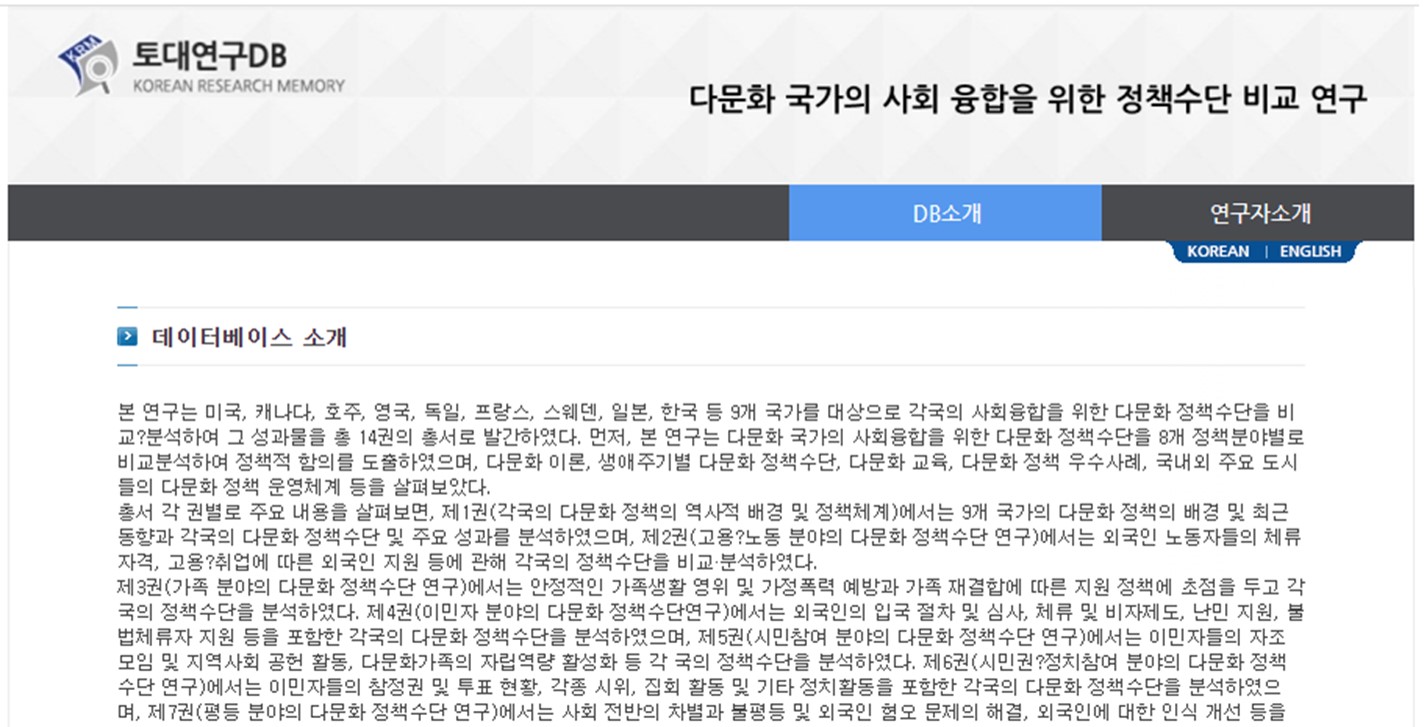
This study compares and analyzes multicultural policy measures for social integration in nine countries, including the United States, Canada, Australia, United Kingdom, Germany, France, Sweden, Japan, and Korea, and presents the results in a series of 14 books. First, this study compared and analyzed multicultural policy measures for social integration in multicultural countries by eight policy fields to derive policy implications. And the multicultural policy operating system of cities was examined. Looking at the main contents of each volume of the series, Volume 1 (Historical background and policy system of multicultural policies in each country) analyzes the background and recent trends of multicultural policies in nine countries, as well as multicultural policy measures and major achievements in each country. Volume 2 (Study on Multicultural Policy Measures in the Field of Employment and Labor) compared and analyzed policy measures in each country regarding the status of residence for foreign workers and foreign support for employment and employment. In Volume 3 (Study on Multicultural Policy Measures in the Family Field), each country's policy measures were analyzed, focusing on policies to support stable family life, prevention of domestic violence, and family reunification. Volume 4 (Study on Multicultural Policy Measures in the Field of Immigrants) analyzed multicultural policy measures of each country, including entry procedures and examinations for foreigners, sojourn and visa systems, support for refugees, and support for illegal immigrants. In the study of multicultural policy measures), each country's policy measures were analyzed, such as immigrants' self-help groups, community contribution activities, and revitalization of self-reliance capabilities of multicultural families. In Volume 6 (Study on Multicultural Policy Measures in the Field of Civil Rights and Political Participation), multicultural policy measures of each country were analyzed, including immigrants' suffrage and voting status, various demonstrations, assemblies, and other political activities. In Volume 7 (Study on Multicultural Policy Measures in the Field of Equality), multicultural policy measures of each country were analyzed, focusing on solving issues of discrimination, inequality and xenophobia in society as a whole, and improving awareness of foreigners. And in Volume 8 (Study on Multicultural Policy Measures in the Education Field), policy measures were analyzed focusing on early language and cultural education, psychological support for school adaptation, and guidance for higher education. In Volume 9 (Research on Multicultural Policy Measures in the Health and Welfare Field), policy implications and implications were derived by analyzing policy measures and outcomes, focusing on the provision of various welfare services and medical support. Volume 10 (Study on multicultural policy measures by settlement stage and life cycle in each country) includes low birth rate and aging society and multicultural policy, multicultural policy by settlement stage and life cycle, direction for improvement of multicultural policy by settlement stage in Korea, and life cycle in Korea. The direction of improvement of multicultural policy was suggested. Volume 11 (Multicultural Theory and Major Issues in Multicultural Society) analyzed trends in multicultural theory, search for a new paradigm, analysis of trends in multicultural studies in Korea, and major issues in multicultural phenomena. Volume 12 (Best Practices of Multicultural Education and Multicultural Policies in Each Country) examined the multicultural acceptability of foreign students, issues and tasks of Korean multicultural education policies, multicultural society and global citizenship education, and best practices of multicultural policies in each country. Volume 13 (Reflection and Prospects of Multicultural Policies in Each Country) analyzes major issues in each country regarding the reflection and prospects of multicultural policies
Expect Effect / Research Utilization
The results of this study are expected to be valuable research data for experts and practitioners studying multicultural policies to develop various multicultural policy tools for social integration. In more detail, the expected effects and utilization plans of the results of this study are as follows. First, from an academic point of view, the results of this study are expected to be used as meaningful basic data for various follow-up studies by further elaborating and developing the theory of social integration and multicultural policy. It is expected to form a social consensus for the realization of multiculturalism in a multicultural society and to provide an academic discourse for social integration. In addition, it is expected to be used as meaningful basic data for various follow-up studies by further elaborating and developing social convergence multicultural policies and programs. Second, in terms of social policy, the results of this study are expected to be useful in developing and implementing multicultural policy tools from a comprehensive and systematic perspective. It will be possible to contribute to the development of comprehensive and systematic multicultural policies by benchmarking the best practices of multicultural policies and programs promoted by advanced multicultural countries. In addition, it is expected to contribute to the establishment of intergovernmental and government-private governance in the establishment and implementation of multicultural policies through the development of multicultural policies and programs applicable to the Korean society. Third, in terms of education, the results of this study will contribute to the development of various discussions related to multiculturalism by forming numerous discourses in which members of society increase the social value of diversity and understand and analyze issues in a multicultural society. Through this, it will be able to contribute to increasing the multicultural acceptability and sensitivity of members of society and enhancing the value of diversity. In addition, the results of the comparative study on multicultural policy measures can be used as major subjects or educational programs in the field of multicultural policy, and are expected to be used as educational materials for field workers such as multicultural education centers and multicultural support centers. Fourth, in terms of manpower training, through this research process, multicultural policy-related professional manpower were trained. Considering the interdisciplinary nature of multicultural policy research, it is expected to promote the cultivation of multicultural experts with expertise in various social science fields such as public policy, public administration, sociology, social welfare, women's studies, and immigration studies. Lastly, from the perspective of sharing and disseminating research results, publishing a series of results to share and spread the results of this research is meaningful in developing and implementing multicultural policies for social integration through networks with various stakeholders. It is expected to provide policy implications. Through this, it is expected to form a new paradigm in which the existing support-oriented multicultural policy is converted into a social participation-oriented multicultural policy
Project Name : Basic Research Support for Foundational Human/Social Science Researches
